
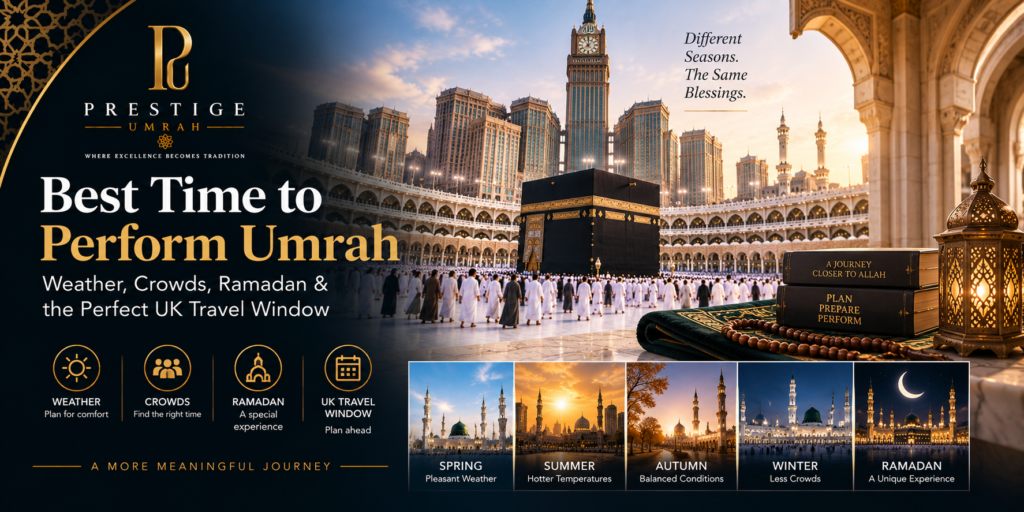
When is the best time to perform Umrah? It is one of the first questions many pilgrims ask when they begin planning their journey from the UK. But unlike booking an ordinary holiday, there is no single month that can be labelled “best” for everyone. The right time depends on what you value most: comfortable weather, a quieter atmosphere, Ramadan, family availability, school holidays, premium hotel availability or simply having enough time away from work. For a pilgrim seeking a premium Umrah experience, timing becomes even more important because the objective is not merely to find an available flight. It is to create a journey where the climate, accommodation, travel schedule and overall pace complement the spiritual purpose of the pilgrimage. Saudi Arabia’s official tourism information currently shows just how different the seasonal climate can be, with Madinah’s predicted temperatures ranging from approximately 8–26°C in winter to 26–45°C in summer. Ramadan adds another dimension because of its exceptional spiritual significance, while UK families must also work around school calendars that vary by council and school. So, rather than asking for a universal “best month,” it makes more sense to ask: what kind of Umrah experience are you looking for? This guide explores the seasons, Ramadan, UK school holidays, weather, crowd considerations and premium travel options to help you choose the right time for your journey.
Is There Really a Best Time to Perform Umrah?
There is no universally perfect time for Umrah because every pilgrim arrives with different priorities. Someone travelling with elderly parents may place comfortable weather at the top of the list, while another pilgrim may consider Umrah in Ramadan an experience worth planning their entire year around. A family with school-age children may be restricted to Easter, summer or half-term holidays, while a couple with greater flexibility may be able to choose dates based almost entirely on weather and hotel availability. There is also a difference between the “best” time from a travel perspective and the “best” time from a spiritual perspective. Cooler weather can make walking and moving between accommodation and the Haram more comfortable, while Ramadan offers a uniquely spiritual atmosphere that many Muslims deeply value. The right answer therefore depends on the purpose of your journey. From a premium travel perspective, timing should be considered alongside hotel location, flight convenience, length of stay and transportation. The aim is to create a pilgrimage that feels comfortable without losing sight of why you are travelling. Instead of searching for one magical month, think of the year as offering different types of Umrah experiences, each with its own character, advantages and considerations.
The Best Time for Umrah at a Glance
Different seasons can suit different types of pilgrims. The table below provides a starting point, but your individual circumstances should determine your final choice.
| Period | Weather | Crowds | Best For | Premium Consideration |
| Winter | Cooler | Variable | Comfort, families, elderly | Excellent time for comfortable travel |
| Spring | Mild to warm | Variable | Couples, families | Good balance of climate and experience |
| Summer | Very hot | Variable | Flexible travellers | Premium hotels and private transfers become more valuable |
| Autumn | Warm to hot | Variable | Flexible travellers | Good transition period |
| Ramadan | Varies by year | High | Spiritual experience | Book premium accommodation early |
| UK School Holidays | Depends on season | Often higher | Families | Secure preferred hotels and flights early |
The key point is that weather and demand change throughout the year, while Ramadan moves through the Gregorian calendar because the Islamic calendar is lunar. Ramadan 2027 is currently expected to begin around 8 February 2027, although the date remains tentative because the Islamic month begins according to moon sighting.
Winter Umrah: Is It the Best Season?
For pilgrims who prioritise comfortable weather, winter is one of the most attractive periods to consider. Saudi Arabia’s western region can still feel warm compared with the UK, but winter temperatures are generally far more manageable than the intense heat experienced during summer. Official Saudi tourism information currently lists Madinah’s predicted winter temperatures at approximately 8–26°C, compared with summer ranges reaching approximately 26–45°C. That difference can matter considerably during Umrah because the pilgrimage involves walking, waiting, travelling between locations and spending time outdoors. Cooler conditions can make the overall experience more comfortable, particularly for elderly pilgrims and families with young children. Winter can also make it easier to structure your day around prayer without feeling physically overwhelmed by the heat. For a premium traveller, winter provides an opportunity to combine comfortable weather with carefully selected five-star accommodation and private transportation. You may not need to spend as much energy managing the physical effects of the climate, which leaves more room for worship and reflection. However, winter dates can still coincide with periods of higher UK travel demand, particularly around Christmas and New Year. So while winter may be attractive from a weather perspective, it is still worth checking your exact dates before deciding.
Why Winter Can Be Ideal for Elderly Pilgrims
For elderly pilgrims, weather can be one of the most important factors when planning Umrah. Walking between accommodation and the Haram, navigating airports, transferring between Makkah and Madinah and spending time outdoors can become considerably more demanding when temperatures are high. Cooler periods can make these activities easier to manage, although individual health and mobility should always be considered separately. This is where a premium travel experience can add genuine value. Choosing a hotel with convenient access, arranging private transportation and allowing a slower itinerary can reduce unnecessary physical strain. Instead of trying to fit everything into a tightly packed schedule, a premium itinerary can create more time for rest between prayers and journeys. The objective is not to make the pilgrimage effortless — Umrah naturally requires physical effort — but to remove avoidable difficulties. For families travelling with elderly parents, this can be especially important. The hotel should be selected based on accessibility and convenience rather than simply its star rating. Private transfers can reduce waiting and walking. A carefully timed flight can reduce fatigue. When these details are considered together, the season becomes part of a much larger experience. For many elderly travellers, a cooler period combined with thoughtful planning can make the journey significantly more comfortable.
Spring Umrah: A Balanced Choice
Spring can offer an attractive middle ground for pilgrims who want to avoid the most intense summer conditions without necessarily travelling during the cooler winter period. As the Gregorian calendar progresses, temperatures in Saudi Arabia gradually rise, but the conditions can still be more manageable than the peak of summer. Official Saudi tourism information shows Madinah moving from winter ranges of approximately 8–26°C towards spring temperatures around 18–41°C. That range illustrates why exact travel dates matter. Early spring and later spring can feel quite different. For couples and families who have flexibility, spring can provide an appealing combination of weather and availability. It can also be a useful period for pilgrims who want a premium journey without necessarily travelling during the most sought-after religious or school-holiday periods. A well-planned spring itinerary can include comfortable five-star accommodation, private transfers and sufficient time in both Makkah and Madinah. The important thing is not to treat “spring” as one uniform experience. Look at the actual dates, expected temperatures and travel demand. A few weeks can make a noticeable difference. Premium planning means looking at those details before confirming the journey rather than assuming that a particular season automatically guarantees ideal conditions.
Summer Umrah: Is It Too Hot?
Summer presents a very different experience. Saudi Arabia’s western region can become extremely hot, and official Saudi tourism information currently shows Madinah summer temperature ranges reaching approximately 26–45°C. For many pilgrims, particularly those travelling with elderly relatives or young children, this can make outdoor movement more demanding. However, that does not mean summer Umrah is unsuitable. Thousands of pilgrims travel during warmer periods, and good planning can make a substantial difference. Premium accommodation becomes particularly valuable because proximity to the Haram can reduce unnecessary walking. Private transportation can make airport and intercity journeys more comfortable. A carefully structured itinerary can avoid unnecessary outdoor activity during the hottest parts of the day. Travellers can also make better use of indoor spaces and plan rest periods around their worship. For someone whose annual leave or family commitments make summer the only practical option, the focus should not be on whether summer is “good” or “bad.” Instead, ask how the journey can be designed to suit the climate. This is where a premium travel adviser can add real value. The season may be hot, but the experience does not have to feel unnecessarily difficult.
The Value of Premium Travel During Hot Weather
Hot-weather travel is one area where premium Umrah services can provide practical value, rather than simply adding luxury for appearance. Consider the difference between walking a considerable distance with luggage after arriving at the airport and stepping directly into a private air-conditioned vehicle. Or compare a hotel that requires significant walking with one that offers much more convenient access. The difference becomes even more noticeable when travelling with children or elderly parents. Private transportation can reduce time spent outdoors, while a well-positioned hotel can allow pilgrims to return to their room more easily. A carefully planned itinerary can also ensure that travel between Makkah and Madinah is comfortable and appropriately timed. These details are particularly important during hotter months. Premium travel should therefore be thought of as comfort intelligently designed around the environment. You are not paying simply for a luxury vehicle or a five-star room. You are investing in an experience where the practical challenges of the climate have been anticipated. For Prestige Umrah, this is an important distinction. Premium service should always have a purpose. If an upgrade genuinely improves comfort and allows the pilgrim to focus more fully on worship, it becomes part of the experience rather than an unnecessary extra.
Autumn Umrah: A Transitional Experience
Autumn can be another interesting period for pilgrims with flexible schedules. Conditions begin to move away from the intense summer heat, although temperatures can remain warm, particularly earlier in the season. Official Saudi tourism information currently shows Madinah autumn temperatures ranging approximately from 19–38°C. This makes exact dates particularly important. An early-autumn journey may feel quite different from a later-autumn itinerary. For travellers who want to avoid both the strongest summer heat and the busiest periods associated with certain holidays, autumn can offer an attractive opportunity. Couples and travellers without school commitments may find this flexibility particularly useful. A premium itinerary during autumn could combine carefully selected five-star hotels with private transfers and a longer stay, allowing the traveller to enjoy a more relaxed pace. As always, demand and pricing depend on the actual dates rather than the season name alone. This is why a professional travel consultation should begin with your availability. Once your preferred window is known, the agency can consider flights, hotels, weather and the overall pilgrimage schedule together.
Umrah During Ramadan: A Completely Different Experience
For many Muslims, the question of the best time to perform Umrah has a very different answer when Ramadan enters the conversation. Ramadan is not simply another travel season. It changes the rhythm and atmosphere of the entire journey. The Ministry of Hajj and Umrah’s own Umrah guide highlights the special virtue associated with performing Umrah during Ramadan while clarifying that the equivalence mentioned in the hadith relates to reward and merit and does not replace the obligation of Hajj. Ramadan can bring an extraordinary atmosphere of worship, prayer, Qur’an and reflection, particularly in Makkah and Madinah. But it also requires careful planning. Fasting, late-night prayers, increased crowds and changing daily routines can make the pilgrimage physically and logistically different from an ordinary Umrah journey. For premium pilgrims, the value of good accommodation and convenient transportation can become especially apparent. A centrally located hotel can make it easier to return for rest between prayers. Private transfers can reduce waiting. A comfortable room provides a peaceful place to recharge. Ramadan Umrah is therefore not simply about paying more or choosing a luxury hotel. It is about creating the right environment for worship.
When Is Ramadan in 2027?
Because Ramadan follows the Islamic lunar calendar, its dates move earlier each year in the Gregorian calendar. Current calendar calculations place the expected start of Ramadan 2027 around Monday, 8 February 2027, although this remains a tentative date because the beginning of Ramadan is determined through moon sighting. This is important for UK pilgrims planning ahead. Someone looking at “Ramadan Umrah” should not assume that Ramadan will always fall during the same UK season. Over time, Ramadan moves through winter, autumn, summer and spring. This creates different travel experiences from one year to another. For example, a future Ramadan occurring during cooler UK and Saudi months may provide a very different physical experience from one occurring during the hotter part of the year. Premium travellers should therefore consider both the spiritual calendar and the climate when planning. If you are considering Ramadan Umrah in a future year, begin by identifying the expected dates, then look at UK school holidays, annual leave and preferred hotel availability. The final dates should always be confirmed closer to the time because Islamic dates depend on lunar observation.
Is Ramadan the Best Time for Umrah?
For a pilgrim seeking the spiritual significance of Ramadan, it can be an extraordinary time to perform Umrah. But “best” remains personal. Ramadan can involve higher demand, more crowded areas and a different daily rhythm, while fasting adds another physical dimension to the journey. Some pilgrims find this deeply rewarding; others may prefer a quieter Umrah outside Ramadan where they can worship at a slower pace. There is no right or wrong answer. The important thing is to understand the experience you are choosing. If your priority is the unique spiritual atmosphere of Ramadan, then the additional planning and potential travel investment may be worthwhile. If your priority is comfort, flexibility and a more relaxed environment, another period may suit you better. The Ministry of Hajj and Umrah specifically recognises the enhanced virtue associated with Umrah in Ramadan, making the month spiritually significant for pilgrims. Prestige Umrah should therefore present Ramadan not as simply the “most expensive” season, but as a distinct pilgrimage experience. The role of premium travel is to make that experience more comfortable and organised, allowing pilgrims to concentrate on worship rather than logistics.
The Final Ten Nights of Ramadan
For many pilgrims, the last ten nights of Ramadan are among the most spiritually significant nights of the year. They are associated with intense worship and the search for Laylat al-Qadr, making Makkah and Madinah especially meaningful destinations during this period. From a travel perspective, however, the final ten nights also require exceptional preparation. Demand for accommodation and flights can be very high, and premium hotel rooms in highly desirable locations can become difficult to secure. This is precisely where early planning matters. If you want a five-star hotel close to the Haram, a preferred room category, premium flights and private transportation, you should not approach the journey as a last-minute holiday booking. You are planning a high-demand pilgrimage period where your preferred options may be limited. A premium travel agency can help you structure the journey well in advance and identify which elements are most important. Perhaps the hotel location is non-negotiable while the flight can be flexible. Or perhaps the opposite is true. The key is to identify your priorities early. The final ten nights are about worship, not travel logistics. The better those logistics are organised beforehand, the more attention you can give to the spiritual purpose of your journey.
Umrah During UK School Holidays
For families, the best time for Umrah is often determined by the school calendar rather than personal preference. Parents may have limited opportunities to travel without taking children out of school, making half-term, Easter and summer holidays particularly important. However, UK school dates are not completely uniform. The UK government notes that school term and holiday dates vary across the UK and recommends checking the relevant local authority or school. This means a family in Birmingham may have slightly different dates from one in London, Manchester or another part of the UK. For premium family travel, this flexibility can sometimes be useful. If your school’s holiday begins on one date but another local authority’s dates differ, there may be an opportunity to choose less congested travel dates. Families should also consider the travel time itself. A seven-night trip may not provide seven full usable days because departure and arrival times can reduce the practical time available. A ten-day itinerary may therefore feel more comfortable. The best approach is to start with your exact school holiday window, then work backwards to identify suitable flights, hotels and travel duration.
Easter Umrah for UK Families
Easter can be an attractive period for UK families because children are generally away from school for an extended holiday. However, the exact dates differ between schools and councils, and families should confirm the dates directly before making travel arrangements. Easter travel can also coincide with increased international demand, so premium hotel availability should be considered early. For families seeking a refined experience, the priority should be a comfortable itinerary rather than simply fitting the maximum number of nights into the school break. Think about flight timings, room configurations and the pace of the journey. Children can become tired after long-haul travel, while parents may appreciate having a day or two where the itinerary is intentionally slower. A centrally located Makkah hotel can make a considerable difference because the family can return to the room more easily. Private transportation can also simplify the journey between cities. Premium travel is particularly valuable for families when it reduces friction. The journey should feel organised enough that parents can focus on their children and worship rather than constantly managing logistics.
Summer Holiday Umrah for Families
The long UK summer holiday gives families the most flexibility in terms of available time, but it can also coincide with some of the hottest conditions in Saudi Arabia. Official Saudi tourism information currently shows Madinah summer temperatures reaching approximately 45°C at the upper end of its predicted range. This does not make summer Umrah impossible, but it does make planning more important. Families should think carefully about hotel location, private transportation, rest periods and daily schedules. A premium hotel close to the Haram can significantly reduce unnecessary exposure to the heat. Private transfers can make longer journeys more comfortable. A slower itinerary can help children and older relatives manage the climate. Families should also remember that school holidays vary by location and school, so they should confirm exact dates before booking. If summer is the only realistic travel window, don’t focus on whether it is the “best” season. Focus on how to make the summer journey the best possible experience for your family. That is a much more useful question.
Winter vs Summer Umrah
The difference between winter and summer can be substantial, particularly for travellers who expect to spend significant time walking outdoors. Official Saudi tourism information currently places Madinah’s predicted winter range around 8–26°C compared with approximately 26–45°C in summer. This does not mean winter is automatically better. Some pilgrims have work or school commitments that make summer the only practical option. Others may specifically want to travel during Ramadan regardless of the season in which it falls. The comparison is therefore useful for understanding the experience rather than deciding a universal winner.
| Factor | Winter Umrah | Summer Umrah |
| Daytime comfort | Generally more comfortable | Significantly hotter |
| Walking | Usually easier | More physically demanding |
| Elderly travellers | Often preferable | Requires more planning |
| Families | Comfortable option | Requires heat-conscious planning |
| Premium hotel location | Valuable | Especially valuable |
| Private transfers | Helpful | Particularly useful |
| Outdoor visits | Generally easier | Better planned around heat |
| Overall pace | Can be relaxed | Rest becomes more important |
The key takeaway is simple: the hotter the conditions, the more valuable thoughtful logistics become.
What Is the Best Month for Umrah?
It is tempting to search Google for one answer to “best month for Umrah,” but the question is too broad to have a universal answer. If your priority is weather, cooler months can be attractive. If your priority is Ramadan, then the Islamic calendar determines your timing. If you are travelling with children, school holidays may dictate your options. If you are looking for premium hotel availability, you may prefer dates outside the busiest periods. Current official Saudi tourism information confirms substantial seasonal temperature variation in Madinah, while the Ministry of Hajj and Umrah highlights the particular spiritual virtue of Ramadan. Therefore, the “best month” is really the month that best matches your priorities. For a premium traveller, it may be a month where the weather is comfortable, the preferred hotel is available and the itinerary can be paced properly. For another pilgrim, the best month may be Ramadan because the spiritual purpose outweighs considerations of climate and demand. There is no contradiction. Umrah is personal, and the travel strategy should be personal too.
How Crowds Affect Your Umrah Experience
Crowd levels can influence how pilgrims experience the holy cities, although they can change significantly from one day and period to another. Ramadan, particularly its latter part, can create an especially intense atmosphere. School holidays and popular travel periods can also affect hotel and flight demand. For a premium traveller, the objective should not be to expect an empty Makkah or Madinah. That would be unrealistic. Instead, good planning can help you navigate busy periods more comfortably. Hotel proximity becomes more valuable when there are more people travelling. Private transportation can reduce waiting. Having a flexible daily routine can help you avoid unnecessary movement during the busiest periods. A well-located hotel can also provide a convenient place to rest between prayers. The experience of pilgrimage naturally involves being among other Muslims, and the presence of large numbers of worshippers can itself be deeply moving. The premium approach is not about escaping the atmosphere of Umrah. It is about ensuring that the surrounding logistics do not become unnecessarily stressful. Good travel planning gives you the comfort to embrace the experience rather than constantly worrying about how to manage it.
Does the Length of Your Stay Affect the Best Time?
Yes. The ideal season can also depend on how long you plan to stay. A short seven-day Umrah requires a relatively efficient itinerary because there is little time to recover from long flights or delays. A ten- or fourteen-day journey allows more flexibility and can make hotter periods easier to manage because you can deliberately slow down. If you are travelling during Ramadan, a longer stay can also provide more time to settle into the fasting and prayer routine. Premium travellers often benefit from considering pace as part of the itinerary. Instead of asking only how many nights are necessary, ask how many nights will allow you to enjoy the journey without feeling rushed. A longer stay may provide more opportunities for rest and reflection, while a shorter stay may suit professionals with limited annual leave. Neither is inherently superior. The important thing is that the duration matches the season, the travellers and the purpose of the trip. If you are travelling during a hotter period, additional rest days can be particularly valuable. If you are travelling during Ramadan, extra time can allow you to experience the month without constantly moving between hotels and airports.
Choosing the Right Hotel for the Season
Your hotel becomes increasingly important when weather conditions are challenging or when your itinerary is particularly demanding. During cooler periods, travellers may be willing to stay slightly farther from the Haram if other aspects of the hotel are attractive. During hot weather, proximity can become much more important. The same applies during Ramadan, when pilgrims may want to return to their hotel regularly between prayers and periods of rest. A premium hotel should therefore be selected according to the season and itinerary, not just the star rating. In Makkah, consider the practical access to the Haram. In Madinah, consider the route to Al-Masjid an-Nabawi. For families, consider room configuration. For elderly travellers, consider accessibility and walking distance. Premium travel means matching the property to the journey. This is why Prestige Umrah should avoid offering a generic list of five-star hotels and instead explain why a particular property may be suitable for a particular traveller. The right hotel can transform the experience because it becomes the place where you recover, rest, pray and prepare for the next part of your journey.
When Should You Book for the Best Experience?
If you have specific requirements, early planning is strongly recommended, especially for Ramadan, school holidays and premium accommodation. The reason is not simply price. It is availability. A premium traveller may want a specific hotel, a particular room category, a preferred airline, private transportation and a certain number of nights in each city. Each additional requirement reduces the number of combinations that will work. During high-demand periods, the best options can disappear first. Planning early gives you greater control over the experience. It also allows you to compare different dates. Perhaps travelling three days earlier gives you access to a better room category. Perhaps moving the return flight by one day allows a more convenient itinerary. These are the kinds of decisions that can make a premium journey feel genuinely personalised. The UK government also advises travellers to check current travel requirements and plan appropriately, while school holiday dates should be confirmed directly because they can vary by school and local authority. The earlier you know your preferred window, the easier it becomes to design the journey around it.
How Prestige Umrah Can Help You Choose the Right Time
At Prestige Umrah, the conversation about timing should begin with the traveller rather than a calendar. Are you travelling with children? Are elderly parents joining you? Is Ramadan important to you? Do you have flexibility around annual leave? Is weather your priority? Would you prefer a quieter, slower journey? Do you want five-star accommodation close to the Haram? Once those questions are answered, the right travel window becomes much easier to identify. Premium travel is about curation, and timing is one of the most important parts of that curation. The ideal journey brings together your preferred dates, suitable flights, carefully selected hotels and comfortable transportation. It should feel as though every part belongs together. Prestige Umrah can help pilgrims compare different travel windows and understand the practical differences between them, while reminding travellers that the spiritual purpose of Umrah remains at the centre. The goal is not simply to find an available week in the calendar. It is to create a journey where the conditions support worship, comfort and reflection. That is the difference between booking a trip and planning an experience.
Conclusion
So, when is the best time to perform Umrah? The answer depends on the experience you want. Winter can offer more comfortable temperatures, particularly for elderly travellers and families, while spring and autumn can provide useful transitional periods. Summer can be challenging because of the heat, but careful planning, premium accommodation and private transportation can make the journey considerably more comfortable. Ramadan is a completely different proposition, offering exceptional spiritual significance while also bringing additional planning considerations. The Ministry of Hajj and Umrah highlights the special virtue associated with Umrah during Ramadan, while current calculations place Ramadan 2027 around 8 February, subject to moon sighting. For UK families, school holidays may ultimately determine when travel is possible, and these dates should always be confirmed with the relevant school or local authority. For a premium pilgrim, the perfect time is therefore not necessarily the cheapest or least crowded period. It is the period that allows your flights, accommodation, weather, itinerary and personal circumstances to work together beautifully. At Prestige Umrah, that is the philosophy worth carrying through every journey: thoughtful planning, carefully selected services and an experience designed around the pilgrim.
Frequently Asked Questions
What is the best time to perform Umrah?
There is no single best time for everyone. Cooler months can be attractive for comfort, Ramadan is particularly significant spiritually, and UK school holidays may determine when families can travel. Your priorities should determine the ideal period.
Which month has the best weather for Umrah?
Generally, the cooler months can provide more comfortable conditions than summer. Saudi Arabia’s official tourism information currently shows substantial seasonal variation in Madinah, with predicted winter temperatures around 8–26°C compared with summer temperatures reaching approximately 45°C.
Is Umrah in Ramadan better than Umrah at other times?
Ramadan has exceptional spiritual significance, and the Ministry of Hajj and Umrah specifically highlights the virtue of Umrah performed during Ramadan. Whether it is the right time for you depends on your spiritual priorities, physical comfort and travel circumstances.
When is Ramadan in 2027?
Ramadan 2027 is currently expected to begin around 8 February 2027, although the date is tentative because the beginning of Ramadan is determined through lunar observation.
Is summer a good time for Umrah?
Summer can be suitable if your schedule requires it, but temperatures can be very high. Premium accommodation close to the Haram, private transportation and a slower itinerary can help make summer travel more comfortable.
Is winter the best time for elderly people to perform Umrah?
For many elderly pilgrims, cooler weather can make walking and outdoor movement more comfortable. However, individual mobility and circumstances should always be considered when planning the journey.
When should families book Umrah during school holidays?
Families should begin planning early, particularly if they require several rooms, specific hotels or premium flights. UK school dates vary by location and school, so confirm your exact holiday dates before booking.
Is Ramadan Umrah more expensive?
It can be. Demand for flights and accommodation can be higher during Ramadan, especially around the final ten nights. Premium hotel availability can also become more limited, making early planning particularly important.
What is the best time for a luxury Umrah?
For a luxury Umrah, the best time is the period that allows you to combine your preferred weather, hotel availability, flights and itinerary. If comfort is your priority, cooler periods may be attractive; if Ramadan is your priority, the spiritual significance may outweigh the additional travel considerations.
Does Prestige Umrah offer Umrah packages throughout the year?
Prestige Umrah can plan journeys around travellers’ preferred dates and requirements, subject to current Saudi regulations, flight availability and accommodation availability. Travellers should confirm current arrangements when enquiring.